
California cut Uber and Lyft’s uninsured motorist coverage to $60,000 per person and $300,000 per crash in 2026, down from $1 million. The separate $1 million at-fault liability layer did not change. What to know, and one decision to make.
It is 11 p.m. and you are in the back seat of an Uber heading west on the 134. A car runs a red light and hits you, and its driver carries no insurance at all. Until January, the trip coverage that answered the question forming in your head, who pays for my ER visit, was a $1 million policy. Today it is $60,000. The change is already in effect, and most online coverage mixes up which layer actually changed. This article untangles it.
The one question that matters: who pays when the other driver has nothing
Set aside the headlines and ask the question a rider actually cares about: if another driver hits the car you are riding in, and that driver carries little or no insurance, who pays for your injuries. While a passenger is in the vehicle, a stage the industry calls period 3, Uber and Lyft were required to carry $1 million in uninsured and underinsured motorist coverage, known as UM/UIM, for that passenger, a requirement in place since 2015 under AB 2293.
SB 371 changed that number. Effective January 1, 2026, the period 3 UM/UIM coverage dropped to $60,000 per person and $300,000 per crash. Read the bill’s text at the official Legislature bill page for SB 371, or a plain-language summary on CalMatters’ bill page.
What gets lost in most coverage of this change: SB 371 touched only the UM/UIM layer, the money that stands in for an at-fault driver who cannot pay. It did not touch the separate $1 million liability policy that applies when the rideshare driver themselves causes the crash, covering periods 2 and 3, which remains unchanged. Two different pots of money answering two different questions, and treating them as one number is the most common mistake in the coverage of this law.
The before-and-after, period by period
Rideshare insurance in California is built around three “periods” describing where the driver is in the app, and the coverage available depends entirely on which period a crash happens in. Here is how each period looked before SB 371 and how it looks now under the amended statute. Note that the California Public Utilities Commission’s TNC insurance requirements page still sets out the pre-SB-371 framework; as of this writing it has not been updated for the new law.
| Period | What the driver is doing | Liability coverage if the rideshare driver is at fault | UM/UIM coverage for the passenger |
|---|---|---|---|
| Period 1 | App on, waiting for a ride request | A lower, CPUC-set tier of commercial liability coverage, well under the period 2 and 3 amount | None, before or after SB 371 |
| Period 2 | Ride accepted, driving to pick up the rider | $1 million, unchanged | None, before or after SB 371 |
| Period 3 | Passenger is in the car | $1 million, unchanged | Before January 1, 2026: $1 million. After: $60,000 per person, $300,000 per crash |
Two honest ways to describe the size of the cut, and they are different measures. Per injured person, the ceiling fell from $1 million to $60,000, about a 94 percent cut. Per crash, the total available fell from $1 million to $300,000, about a 70 percent cut. Neither framing is wrong: the first describes what changed for one badly injured passenger, the second what a full car now shares.
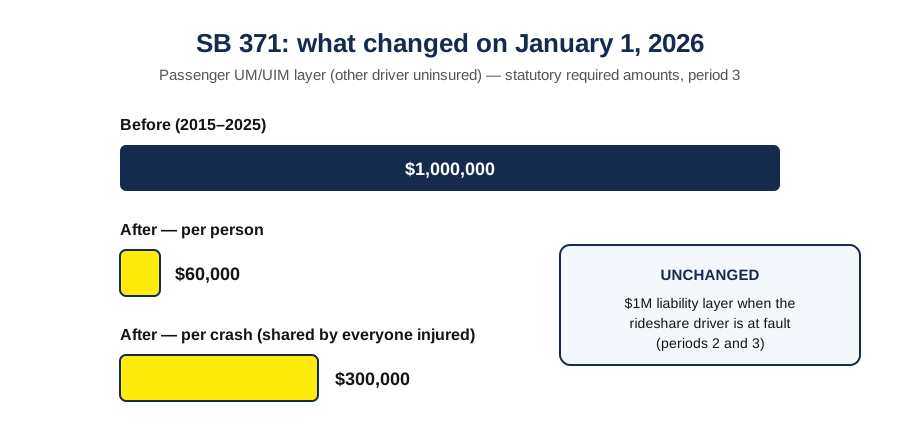
SB 371 cut only the UM/UIM layer. The $1 million liability layer for crashes the rideshare driver causes did not change.
Why the coverage fell: the trade nobody explains
SB 371, authored by Senator Christopher Cabaldon and chaptered as Chapter 314, was expressly contingent on AB 1340, the TNC Drivers Labor Relations Act, which lets Uber and Lyft drivers bargain collectively through the Public Employment Relations Board while remaining independent contractors. Governor Newsom signed SB 371 on October 3, 2025, the same day he signed AB 1340. The package was a trade: drivers gained bargaining rights, the companies got a reduced insurance mandate, and Senator Cabaldon’s office presented the coverage cut as a way to lower fares for riders.
One detail worth holding onto: the new floor does not sunset, and nothing snaps back to $1 million on any date. But the Legislature built in a checkpoint. Public Utilities Code section 918.3 orders the Department of Insurance and the Public Utilities Commission to study how the UM/UIM reduction plays out, with findings due to the Legislature by December 31, 2030. The number will be revisited. Until then, $60,000 is the rule.
The three scenarios where the change actually bites
Scenario one: you are a passenger, and the driver who hit you has no insurance or too little. This is the direct case: the layer standing behind you fell from $1 million to $60,000. And it is not rare. The Insurance Research Council reports that in 2023 one in three U.S. drivers (33.4 percent) was either uninsured or underinsured, and more than one in seven (15.4 percent) carried no insurance at all. What to check: whether your own auto policy carries UM/UIM that covers you as a passenger in someone else’s vehicle.
Scenario two: several people are hurt in the same crash. The $300,000 figure is an aggregate, a single pool for the whole collision. If four passengers are seriously injured by an uninsured driver, they do not each get $300,000; all four share it, and no one can draw more than $60,000. Full cars feel this change the hardest. What to check: how your own UM/UIM limits would apply if you were one of several injured people sharing a capped pool.
Scenario three: you drive for a platform, and you are between rides. During period 1, app on and waiting for a request, the TNC policy has never included UM/UIM protection, before SB 371 or after it. Meanwhile, personal auto policies commonly contain livery exclusions that can strip coverage while a car is being used for hire. Prop 22’s separate benefit for drivers, $1 million in occupational accident coverage, is unchanged, but it is its own program with its own rules. What to check: whether your personal policy excludes rideshare use and whether a rideshare endorsement would close the period 1 gap.
What did NOT change
It is easy to read about a 94 percent cut and assume everything fell. These stayed exactly where they were:
- The $1 million liability layer. When the rideshare driver is at fault, from ride acceptance through drop-off (periods 2 and 3), the $1 million in liability coverage is intact.
- Prop 22’s driver benefit. The occupational accident coverage that protects drivers themselves, up to $1 million, is a separate mandate and was not touched.
- Your right to pursue the at-fault driver personally. An insurance floor caps what a policy pays, not what a negligent driver owes. A claim against the driver who caused the crash remains available, whatever their coverage.
- Comparative fault principles. California still apportions responsibility among everyone whose conduct contributed to a crash, the same way it did before January.
The one decision you can make before your next ride
You cannot vote on the platform’s coverage, but you can look at your own. This week, two questions are worth answering about your own coverage. First: does your UM/UIM coverage protect you as a passenger in someone else’s car, including a rideshare? Second: are your limits high enough to matter now that the platform floor is $60,000? Your declarations page and policy documents carry both answers, and an attorney can read them with you.
If you own a car, the practical moment is your next renewal, when you can consider whether your UM/UIM limits still fit the risk you carry. If you do not own a car, household members are typically covered by a resident relative’s UM/UIM policy, so a parent’s or spouse’s coverage may already follow you into a rideshare. Non-owner policies exist, but they are generally liability-only: they cover harm you cause to others and do not pay for your own injuries. This is insurance-shopping information, not legal advice, and not an assertion about what any particular policy covers. For the first time in a decade, the answer genuinely depends on you.
If it already happened: first steps after an LA rideshare crash
If you were hurt in a rideshare crash, the order of operations is short. Get medical care first, even if you feel mostly fine; some injuries announce themselves days later. Report the crash inside the app, which creates a record tied to the trip. Screenshot the trip screen before it disappears: driver, route, time stamps. If you are able, photograph the vehicles and the scene, and get names and numbers for witnesses. We cover the full sequence step by step elsewhere.
And if you drive these streets with kids in the car, coverage is not the only thing that changed this year; enforcement did too.
When to talk to a lawyer
A lawyer earns their place when the injuries are serious, when the coverage layers are disputed, when insurers point at each other over which period applied, or when several injured people are sharing one $300,000 aggregate and the arithmetic turns adversarial. Whether any of that applies to your situation is what a consultation sorts out.
If a language barrier is part of what makes this harder, that barrier can come down. At Lilit Gevorgyan Professional Law Corporation, consultations and representation are available in English, Spanish, Russian, and Armenian.
Talk to us about what happened
If you were hurt in a rideshare crash, tell us what happened. We will evaluate your situation, and if it falls outside our practice, we can connect you with an attorney from a vetted network of California attorneys.
See also: Uber and Lyft Accident Lawyer Serving Los Angeles.
Request a free consultation or call (310) 900-9300.
You pay nothing unless we recover compensation for you. Costs and expenses may apply. See engagement letter for details.
Results depend on the facts of each case; prior results do not guarantee a similar outcome.
Frequently asked questions
Does Uber still cover me if the other driver is uninsured?
Yes, but the amount dropped on January 1, 2026. While a passenger is in the car, Uber and Lyft must carry uninsured and underinsured motorist coverage of $60,000 per person and $300,000 per crash under SB 371. Before that date, the required amount was $1 million. That coverage exists for exactly this situation: a driver outside your trip causes the crash and has no insurance, or not enough, and the trip’s UM/UIM layer covers your injuries as a passenger. The $1 million requirement had been in place since 2015 under AB 2293, so a decade of articles and forum answers now describes a number that is no longer the law. The coverage still applies automatically while you are riding; you do not have to do anything to invoke it. It is simply much smaller than it used to be, which is why your own policy’s UM/UIM terms are suddenly worth reading closely.
How much is Uber and Lyft’s insurance in California in 2026?
It depends on the layer. The $1 million liability policy that pays when the rideshare driver is at fault is unchanged. The uninsured and underinsured motorist coverage for a passenger dropped to $60,000 per person and $300,000 per crash on January 1, 2026.
California ties coverage to what the driver is doing, tracked by the CPUC as periods 1, 2, and 3. Period 1, app on with no ride accepted, carries a lower liability tier and no UM/UIM, unchanged by SB 371. Periods 2 and 3, the drive to pickup and the trip itself, carry $1 million in liability coverage if the driver caused the crash, also unchanged. What changed is the UM/UIM protection for a passenger during period 3, which fell from $1 million per person to $60,000 per person, and from $1 million per crash to $300,000 per crash. Two numbers, two questions, and only one of them moved. Reading a headline that quotes only one figure without naming which layer it describes is one of the easiest ways to come away with the wrong impression of what actually happened on January 1, 2026.
What are rideshare insurance periods 1, 2, and 3?
California divides every rideshare driver’s time into three insurance periods. Period 1 is app on, waiting for a request. Period 2 begins when the driver accepts a trip and is en route to the pickup. Period 3 runs from the moment the passenger enters the car until drop-off. The coverage differs sharply by period. In period 1, only lower liability tiers set under CPUC rules apply, and there has never been a UM/UIM requirement, before SB 371 or after it. In periods 2 and 3, the $1 million liability layer applies for crashes the rideshare driver causes. UM/UIM protection, the layer for crashes caused by uninsured or underinsured strangers, exists only in period 3, and that is the layer SB 371 cut from $1 million to $60,000 per person and $300,000 per crash. The period system explains why two crashes involving the same car can produce different insurance answers depending on what the app showed at impact.
Does my own car insurance cover me while riding in an Uber?
It depends on your policy’s UM/UIM terms, and no article can answer that for you. Many personal auto policies extend uninsured and underinsured motorist coverage to you as a passenger in someone else’s vehicle, including a rideshare, but the terms, exclusions, and limits vary from policy to policy and insurer to insurer. The reliable way to find out is to have your policy’s UM/UIM terms read: your declarations page and policy documents carry the answers, and an attorney can review them with you. The two questions that matter are whether your UM/UIM coverage protects you as a passenger in someone else’s car, including a rideshare, and whether your limits are high enough to matter now that the platform floor is $60,000 per person. If you do not own a car, a resident relative’s policy may cover you, since household members are often protected by a family member’s UM/UIM coverage. Since January 1, 2026, the gap between a good answer and a bad one to those two questions is much wider than it used to be.
What happens if several passengers are hurt in the same crash?
Every injured person shares a single $300,000 pool. Under SB 371, the trip’s uninsured and underinsured motorist coverage carries two caps: $60,000 for any one person and $300,000 total for the entire crash. The second number is an aggregate, not a per-person figure, so it does not multiply with the number of victims. If an uninsured driver hits a rideshare carrying four passengers, all four claims draw from the same $300,000, and no individual claim can exceed $60,000. Before 2026, the required coverage was $1 million per occurrence, so a multi-victim crash had more room before the pool ran dry. This is the scenario where the percentage framings in this article matter most: per person the cut was about 94 percent, per crash about 70 percent, and a full car experiences both at once. When one capped pool must stretch across several serious injuries, how it gets divided becomes its own question.
Did Uber’s $1 million liability coverage change?
No. The $1 million liability layer, the coverage that pays when the Uber or Lyft driver causes the crash, was not touched by SB 371; it remains in place from ride acceptance through drop-off, and what changed is the separate UM/UIM layer for crashes caused by uninsured or underinsured strangers. That layer fell from $1 million to $60,000 per person and $300,000 per crash on January 1, 2026. The distinction matters because much of the online discussion collapses the two layers into one story, leaving readers with the impression that all rideshare coverage shrank, or that none of it did. Neither is true. If your rideshare driver runs the light, the coverage picture looks the same as it did in 2025. If the other car runs the light and its driver has nothing, the picture is very different. Which driver caused the crash now determines far more than it used to.
When did SB 371 take effect, and is it permanent?
SB 371 took effect on January 1, 2026, and the new coverage amount does not sunset. There is no built-in date when the $60,000 per person and $300,000 per crash requirement automatically reverts to $1 million. In that sense, the change is permanent unless the Legislature acts again. But the Legislature left itself a checkpoint: Public Utilities Code section 918.3 directs the Department of Insurance and the Public Utilities Commission to study the effects of the UM/UIM reduction, with findings due to the Legislature by December 31, 2030. That study is the built-in moment when lawmakers will look at real crash and claims data and decide whether $60,000 was the right call. Until then, the number is what it is. For riders, the practical takeaway is not to wait for a fix: the coverage environment for at least the next several years is the reduced one, and personal UM/UIM decisions should account for it.
What if my medical bills are more than the coverage?
Depending on the facts of the crash, other sources of recovery can exist beyond the rideshare’s UM/UIM layer, including a claim against the at-fault driver personally, your own UM/UIM coverage if it applies to you as a passenger, or other parties who may share responsibility.
This describes how the system can work in general, not a prediction about any particular case; whether any of these avenues applies depends entirely on the specific facts. If the rideshare’s $60,000 per-person or $300,000 per-crash limits do not cover the full extent of medical expenses, one path is pursuing the at-fault driver directly, if they have personal assets or their own liability insurance. Another is your own auto policy, if its UM/UIM terms extend to you as a passenger, a question your insurer can answer. Depending on how the crash happened, other potentially liable parties could also come into the picture. None of this is a promise about what any particular claim will recover; it is a description of the categories that can exist, often the starting point for evaluating a specific situation with an attorney.
Do Uber and Lyft drivers need their own rideshare insurance in California?
Often, yes, because the app’s own coverage has a real gap. Period 1, app on but no ride accepted, carries no uninsured or underinsured motorist coverage from the rideshare policy, before or after SB 371, and many personal auto policies exclude for-hire or livery use.
The period 1 gap is one reason rideshare endorsements and dedicated rideshare insurance products exist in California: they bridge the moment between a driver turning the app on and accepting a ride, when a personal policy may not respond fully and the platform’s own coverage is at its lowest tier. A driver who assumes their personal policy covers every hour the app is open, without checking for a livery or for-hire exclusion, can discover the gap only after a crash. Separately, Proposition 22 provides drivers an occupational accident benefit, paying up to $1 million for on-the-job injuries, unaffected by SB 371. Drivers who want to close the period 1 gap should talk to their own insurer about a rideshare endorsement rather than assume their existing policy already covers it.