
Los Angeles approved 125 automated speed cameras in March 2026, and LADOT has set October 26, 2026 for the first systems to activate, with all systems expected by the end of 2026. Warning notices come first; fines follow. Glendale is rolling out its own separate camera program.
The 15 mph school-zone signs went up across Los Angeles last year, and plenty of drivers made their peace with ignoring them. This school year, the signs get backup. Once LA’s first cameras activate on October 26, 2026, and their warning period ends, a speeding ticket near a school will no longer need an officer behind you. It can arrive in the mail.
What is actually new for 2026-27: cameras, not speed limits
The speed limits themselves are not the news this year. The 15 mph school-zone program, covering 343 street segments near 201 schools including private schools inside city limits, was adopted by the City Council back in May 2025 and rolled out for last school year under Council File 14-0348-S1.
What changed in 2026 is enforcement. On March 24, 2026, the City Council adopted the location plan for 125 automated speed safety cameras, the largest network among California’s pilot cities. Installation began in April and continued through the summer alongside the public-awareness campaign state law requires. LADOT’s Speed Safety System page now gives October 26, 2026 as the date the first camera systems activate, and LADOT anticipates that all systems will be activated by the end of 2026. Each site then runs its own 60-day period in which violators receive warning notices with no fine. Actual fines follow those warning windows. In plain terms: this fall, the camera watches whether or not a patrol car is there.
Where cameras can legally go, and where LA is putting them
California’s camera pilot is not a blank check. The enabling law, AB 645, created a pilot for six cities: Los Angeles, Glendale, Long Beach, San Francisco, Oakland, and San Jose. It also restricts where cameras may operate under Vehicle Code section 22425 and the sections that follow it: school zones, designated safety corridors, and locations with a documented speeding problem. The same section is where the warning-period rule lives: subdivision (f)(2) requires warning notices rather than citations during the first 60 calendar days of enforcement, including for each batch of streets added later. School zones are not just eligible; they are a priority category.
LA’s exact live locations publish in phases as installation proceeds, so the honest answer to “is my street getting one” is: check LADOT’s Speed Safety System page, which carries the adopted location list and rollout updates. If your commute passes a school, assume you will meet a camera on some route you drive this year.
Glendale has its own camera program
If you live or work in Glendale, the LA rollout is only half the story. Glendale is a separate city running its own AB 645 pilot, the Glendale Speed Safety Program. The city identified 16 candidate corridors from its collision data, to be narrowed to 9 final camera sites with community input, and approved its camera vendor contract in December 2025. Candidate corridors include stretches of Brand Boulevard, Glenoaks Boulevard, San Fernando Road, Central Avenue, and Chevy Chase Drive. Glendale has not published hard citation-start dates as of this writing, and its program follows the same warning-notices-first structure state law requires.
For the thousands of people who cross the LA-Glendale line every day, the point is simple: two cities, two camera programs, one set of statewide rules, and no assumption that leaving one city’s limits leaves cameras behind.
What a camera ticket actually costs, and what it does not do
Camera citations under AB 645 are civil penalties, and the amounts are set by Vehicle Code section 22426. The schedule is flat: $50 for driving 11 to 15 mph over the limit, $100 for 16 to 25 over, $200 for 26 or more over, and $500 for traveling at 100 mph or faster. A first violation in the lowest tier draws a warning notice instead of a fine. The law also requires reduced penalties for lower-income drivers. Because these are civil penalties issued to the vehicle’s registered owner, a camera citation does not add points to a license and does not trigger a license suspension.
An officer-issued speeding ticket is a different animal. The base fine looks small on paper, but penalty assessments roughly four to five times the base amount get stacked on, which is how a nominal $35 citation becomes roughly $234 in total, and it typically adds one point to your record. One more myth worth retiring: school zones do not automatically double your fine. Doubled fines apply only in separately designated Safety Enhancement Double Fine Zones under Vehicle Code section 42010, which is its own program entirely.
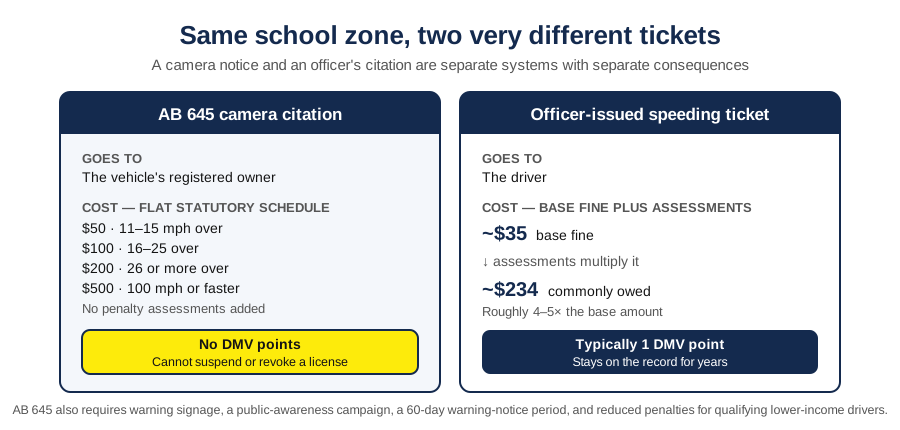
Two tickets from the same school zone, with different recipients, different math, and different consequences for a driving record.
When 15 mph actually applies (the sign is not 24/7)
The 15 mph limit is conditional, and the condition is on the sign. Under Vehicle Code section 22358.4, these zones operate within 500 feet of a school, and the lower limit applies while children are going to or leaving school, during school hours or the noon recess period. Weekends, school holidays, and summer break follow the same logic: the posted condition controls, not the calendar you remember. Streets that never got the special signage still carry California’s default rule, a 25 mph prima facie limit when passing a school while children are outside, under Vehicle Code section 22352.
Two more things worth knowing. First, this is an LA city program built on statewide enabling law, so a neighboring city’s school zones may look different. Second, the numbers will keep moving: under AB 382, chaptered in 2025, California cities may adopt 20 mph school-zone limits now, and from January 1, 2031, state law sets a 20 mph limit in school zones where a posted school sign says it applies, such as a sign with flashing beacons, a “children are present” sign, or a sign with set hours.
A ticket is not a verdict: how speed evidence works in a child-injury claim
Here is the part of this that a news story will not walk you through. If a child is hurt by a speeding driver near a school, the citation and the civil claim run on separate tracks. California’s negligence per se doctrine lives in Evidence Code section 669. A driver who violated a safety law is presumed negligent when four things line up: the violation happened, it caused the injury, the injury is the kind the law was written to prevent, and the injured person is in the class the law protects. A school-zone speed law and a hurt child fit that pattern naturally, which is why speed evidence matters so much in these cases.
But a presumption is not a verdict. The driver can rebut it, causation still has to be proven, and California’s comparative fault system weighs everyone’s conduct, with the important nuance that a child is held to the standard of a child of similar age and experience, not an adult’s. A camera photo, a citation, or the absence of either does not decide a claim by itself. Families should not assume a case is impossible because no ticket was written, and drivers should not assume a ticket means automatic liability. The facts decide, and they get evaluated one case at a time.
A realistic back-to-school checklist for LA and Glendale drivers
All of this takes about ten minutes before August 12.
- Re-drive your regular routes the week of August 3. New camera units and school-zone signage went in over the summer. Spot them before they matter.
- Read the posted hours, not the bell time you remember. Early-release days and campus-specific schedules mean the zone’s active condition can differ from the routine you learned last year.
- Treat drop-off double-parking and mid-block U-turns as the hazard they are. Children crossing mid-block behind a double-parked SUV is the classic dart-out pattern. Use the school’s marked drop-off zone even when it costs two extra minutes.
- Know where the crossing guards are posted, and which corners have none. The unguarded corner one block from school is statistically the lonelier, riskier crossing.
- If you have a teen driver: for the first 12 months, a provisional license generally bars carrying passengers under 20 without a licensed adult 25 or older in the car, under California’s provisional licensing rules. The first weeks of a school year are exactly when that rule gets tested.
- If your teen rides an e-bike to school: since January 1, 2026, California requires a red rear reflector or light visible from 500 feet at all times of operation, per the CHP’s 2026 new-laws bulletin. New e-bike batteries sold in California must also be safety-certified.
See also: California E-Bike Laws for 2027.
When to talk to a lawyer
For a camera notice or a routine speeding ticket, the notice itself explains how to pay or contest it. Where a lawyer earns their place is when someone is hurt: a child struck near a school, a crash during drop-off chaos, a collision where speed is disputed and the evidence needs to be gathered before it disappears. Those situations involve real deadlines and real proof problems, and they deserve more than a guess.
If a language barrier is part of what makes this harder, that barrier can come down. At Lilit Gevorgyan Professional Law Corporation, consultations and representation are available in English, Spanish, Russian, and Armenian.
Talk to us about what happened
If your child or a family member was hurt in a school-zone or drop-off collision, tell us what happened. We will evaluate your situation, and if it falls outside our practice, we can connect you with an attorney from a vetted network of California attorneys.
Request a free consultation or call (310) 900-9300.
You pay nothing unless we recover compensation for you. Costs and expenses may apply. See engagement letter for details.
Results depend on the facts of each case; prior results do not guarantee a similar outcome.
Frequently asked questions
Are speed cameras legal in California now?
Yes, in six pilot cities. AB 645, effective 2024, created a pilot program allowing automated speed cameras in Los Angeles, Glendale, Long Beach, San Francisco, Oakland, and San Jose, codified at Vehicle Code sections 22425 through 22431. Cameras are restricted to school zones, designated safety corridors, and locations with a documented speeding problem, so a city cannot simply place them anywhere it likes. Each city runs its own program on its own timeline, which is why LA’s 125-camera network and Glendale’s smaller 9-site program are separate rollouts with separate schedules. The statute builds in guardrails beyond placement: warning signage where systems operate, a public-awareness campaign before activation, a 60-day period in which violators receive warning notices instead of fines, privacy limits on how plate images are handled, and reduced penalties for lower-income drivers. It is a pilot, so lawmakers will eventually evaluate the results before deciding whether camera enforcement expands statewide, continues, or ends.
Do camera tickets add points to my license or raise my insurance?
No points. AB 645 camera citations are civil penalties issued to the vehicle’s registered owner, and by statute they do not add DMV points and cannot lead to a license suspension or revocation. They are not a moving violation on your driving record the way an officer-issued speeding ticket is, and they do not appear in the court-and-DMV pipeline that traffic convictions follow. Because they are not moving violations, they do not feed the point-based rating systems insurers typically rely on when setting premiums, though every insurer sets its own underwriting practices and this article cannot speak for any particular company. An officer-issued speeding ticket is a different matter entirely: it typically carries one DMV point, points stay visible on your record for years, and points are what insurers see when they re-rate a policy. That difference in consequences is one reason the two systems should never be confused, even though both can arrive because of the same school zone.
How much is a school-zone speeding ticket in California in 2026?
It depends on who issues it, because California now has two separate systems. A camera citation under AB 645 follows a flat statutory schedule: $50 for driving 11 to 15 mph over the limit, $100 for 16 to 25 over, $200 for 26 or more over, and $500 for traveling at 100 mph or faster. A first violation in the lowest tier draws a warning notice instead of a fine, and the law requires reduced penalties and payment plans for qualifying lower-income drivers. An officer-issued ticket works completely differently: it starts from a small base fine set by the statewide schedule, but penalty assessments, the add-ons that fund courts and state programs, multiply the total to roughly four to five times the base amount. That is how a nominal $35 citation commonly becomes a bill of around $234, and unlike a camera notice, the officer-issued version usually adds a DMV point on top of the money.
Can I contest a speed-camera ticket?
Yes. AB 645 citations are civil penalties rather than criminal traffic infractions, so they come with an administrative review process rather than traffic court by default. The notice of violation itself must explain your options, your deadlines, and how to seek review, per Vehicle Code section 22427. That makes the notice the single most important document in the process: read it carefully, calendar the deadline it states, and respond inside that window rather than setting it aside. The law also requires payment plans and reduced penalties for qualifying lower-income recipients, so if the amount is a hardship, the notice should point you to the reduction process rather than leaving you to choose between paying and defaulting. A first violation in the lowest speed tier should arrive as a warning with no fine attached at all. Whatever you decide, keep a dated copy of everything you send back and every response you receive, the same way you would with any dispute that has a deadline.
How do I know if the notice in my mailbox is a warning or a real ticket?
Read the amount. During each camera’s first 60 days of operation, AB 645 requires warning notices that carry no fine, so a document from that window shows nothing due and demands no payment. A real citation states a penalty from the flat schedule, $50 to $500, plus your deadline and review options. Beyond the amount, the two documents do the same basic job: both mean a camera verified your vehicle above the limit in that zone. A warning is the program telling you the camera on that street is now live and that the next event will carry a fine; treating it as junk mail wastes its one useful function. A real citation is governed by Vehicle Code section 22427, which requires the notice to explain how to contest it, how to seek an income-based reduction or a payment plan, and by when. Whichever version arrives, note the location, calendar any deadline printed on it, and adjust the route habit that produced it. The camera will still be there tomorrow.
What if someone else was driving my car when the camera caught it?
The citation still comes to you first. AB 645 camera systems photograph the rear license plate, not the driver’s face, so the citation is issued to the vehicle’s registered owner regardless of who was behind the wheel, which is a deliberate design choice in the statute rather than an error. That is different from an officer-issued ticket, which attaches to the person actually driving. The notice of violation explains how to respond if you were not the driver, and because these are civil penalties that carry no license points, the stakes of an owner-addressed notice are financial rather than a mark on anyone’s driving record. The practical advice is the same for a parent whose teen borrowed the car and a driver whose spouse made the school run. Read the notice’s instructions, respond by the deadline it states, and do not ignore it. An unanswered civil penalty can grow collection consequences far more annoying than the original $50.
Who is liable if a child is hit by a car near a school in California?
It depends on the facts, and often on more than one party’s conduct. A speeding or inattentive driver may be presumed negligent under Evidence Code section 669. The presumption needs four things: a violated safety law like a school-zone speed limit, a violation that caused the injury, harm of the kind the law was written to prevent, and a victim in the class of people it protects. A school-zone speed law and an injured child fit that framework naturally, which is why speed evidence carries real weight in these cases. But California’s comparative fault system examines everyone’s role in what happened, and the law holds a child to the standard of a child of similar age, intelligence, and experience, not to an adult’s standard. Depending on the circumstances, other parties can matter too. No single fact, including a ticket or the lack of one, decides liability by itself; the full circumstances do, and they deserve a careful, honest evaluation before anyone draws conclusions.
When do school zone speed limits apply, weekends and summer too?
The posted condition controls, not the calendar you carry in your head. LA’s 15 mph zones under Vehicle Code section 22358.4 operate within 500 feet of a school, and the lower limit applies while children are going to or leaving school, during school hours or the noon recess period. If school is genuinely not in session on a weekend or during winter or summer break, that condition generally is not met and the street’s ordinary limit applies. But the exceptions are exactly where drivers get caught: summer school sessions, weekend programs and sports, minimum days, and campus-specific schedules can all put children on the street at times your old routine says are safe, and signs posted with specific hours control on their own terms. Streets without the special 15 mph signage still carry the default rule, 25 mph when passing a school while children are outside, under Vehicle Code section 22352. When in doubt, drive as if the zone is active; the downside of being wrong the other way is a child.
Are speeding fines doubled in school zones?
No, not automatically. That common belief confuses two different things. Safety Enhancement Double Fine Zones are their own program under Vehicle Code section 42010. They exist only on specific stretches of road that have been formally designated, usually after a documented history of serious collisions. An ordinary school zone is not one of them by default. So the sign that says SCHOOL 15 is not itself a double-fine trigger. What actually makes school-zone tickets expensive is the same thing that makes every California ticket expensive: penalty assessments, the mandatory add-ons stacked on the base fine, which multiply the total to roughly four to five times the base amount before you ever see the bill. The new camera citations sit outside that machinery entirely, with their own flat statutory schedule starting at $50 and no assessments added. If you have heard both ‘fines double near schools’ and ‘a school ticket is only $35,’ now you know why both are wrong.
When does the 2026-27 LAUSD school year start?
Wednesday, August 12, 2026 is the first day of instruction for LAUSD, per the district’s published calendar, with a pupil-free day on August 11 and the last day of instruction on June 4, 2027. Individual campuses layer their own schedules on top of the district calendar, including minimum days and early-release patterns, which is one reason the posted school-zone hours matter more than the bell time you remember from last year. LADOT has set October 26, 2026 for its first speed cameras to activate, and each camera then issues warning notices only for its first 60 days.
Does a speeding ticket or camera citation automatically prove fault in an injury case?
No. A citation is evidence, sometimes strong evidence, but it is not a verdict, and the two legal tracks should not be confused. Negligence per se under Evidence Code section 669 creates a rebuttable presumption of negligence when a safety-law violation causes the kind of harm the law was designed to prevent, to a person in the class it was designed to protect. A school-zone speed violation that injures a child fits that framework, which is why the presumption matters. But the driver can rebut it by showing they acted reasonably despite the violation, causation still has to be proven with real evidence, and California’s comparative fault system still weighs everyone’s conduct. The reverse is just as important: the absence of a ticket does not mean the absence of a claim. Officers do not witness most collisions, camera programs are new and partial, and speed can be established through physical evidence, witnesses, and reconstruction. Cases are evaluated on their full facts, not on paperwork alone.