
If you have asked a nursing home for your mother’s or father’s records and been told they are “missing,” “lost,” still “being pulled,” or simply never handed to you, the fear that follows is real. When you already suspect something went wrong, a stonewall on the paperwork can feel like proof that the truth is being buried. Grief and suspicion are both legitimate to feel at once. You are not imagining it, and you are not powerless. A California law that took effect at the start of 2026 changed the ground under this exact situation, and it changed it in your family’s favor.
Under California’s AB 251, if a court finds a nursing home or assisted-living facility intentionally destroyed records it had to keep, a family may prove elder abuse under an easier standard: preponderance of the evidence, not clear and convincing.
What AB 251 actually changed (in plain language)
For years, the hardest part of an elder-abuse case has been proof. Under California’s Elder Abuse and Dependent Adult Civil Protection Act, a family seeking the law’s stronger remedies for physical abuse or neglect has had to meet a demanding standard: clear and convincing evidence, higher than the ordinary “more likely than not” used in most civil cases. Families feared that if a facility destroyed the chart, they could never meet it.
Assembly Bill 251, authored by Assemblymember Ash Kalra of San Jose and chaptered as Chapter 433 of the Statutes of 2025, turns that fear around. Governor Newsom signed it on October 7, 2025. Because it is not an urgency statute, it took effect under California’s standard rule for non-urgency laws, on January 1, 2026. It amends Welfare and Institutions Code section 15657 and adds a new section 15657.02, both inside that same Act.
Here is the core of it. When a court finds that the facility destroyed or hid records it was required to keep, the court may let the family prove the elder-abuse claim by the lower preponderance-of-the-evidence standard instead of clear and convincing. In plain terms, a cover-up no longer helps the facility; it can shift the burden of proof against it. That matters because the Act’s stronger remedies, such as attorney’s fees and cost recovery, have long been out of reach for families who could not clear the higher bar. That is what “elder abuse burden of proof” now means in California for these facilities.
One honest caution belongs right here. AB 251 is new, and no California court has yet interpreted it. Anyone who tells you they know exactly how judges will apply it is guessing. A careful lawyer will tell you what is settled and what is still an open question.
What counts as “destroying records,” and which facilities the law covers
This is the part most summaries get wrong, so it is worth slowing down. AB 251 does not treat every missing page as a crime. The law targets spoliation of evidence, which it defines as the intentional and improper alteration, concealment, or destruction of records the facility was required to keep, done with the intent to prevent their production, in a way that materially harms the other side’s ability to make its case. The key word is intentional. A disorganized file, or one page lost by accident, is not the same as records deliberately destroyed to keep them out of your hands.
Two more details matter for your family. First, scope. AB 251 applies to claims against a residential care facility for the elderly (an RCFE), an adult community care facility licensed under the California Community Care Facilities Act, or a skilled nursing facility (an SNF). It does not cover every care setting, and it does not reach in-home caregivers. If your relative was harmed outside those three categories, this specific law may not apply, though other protections still can. Second, the court’s finding of spoliation must be issued in writing, which gives families and lawyers a concrete record to build on.
Why does destruction inside a retention period count? Because a skilled nursing facility is required to keep a patient’s health records for at least seven years after discharge under 22 CCR section 72543. When a facility wipes records that it was legally bound to preserve, and does so to prevent their production, it is not just losing paperwork; it is doing the very thing AB 251 was written to discourage.
How to request your family member’s records right now
You do not have to wait for a lawyer to protect the record. California gives residents and their representatives a fast, enforceable right to the file, and using it this week is one of the most useful things you can do.
Here is the sequence. Make your request in writing and date it. Under the federal rules for nursing homes, the facility must let you inspect the records within 24 hours of your request, not counting weekends and holidays. If you ask for copies, it generally must provide them within two working days. Under California law, it may charge only a reasonable, cost-based fee, capped at 25 cents per page for paper copies (50 cents per page for microfilm).
Know who is allowed to ask. Under the same rules, the resident, a court-appointed guardian or conservator, a health-care agent named under a power of attorney, and a will, trust, or inheritance beneficiary may all request records. Bring the document that proves your role. If the facility refuses you access, you can file a complaint with the California Department of Public Health. None of this promises you will receive every page, but a dated, written trail is what turns a vague suspicion into something a court can examine.
What to do if the facility stalls, refuses, or says the records are “lost”
If you have already hit a wall, here is the ladder to climb, and a reassuring fact to hold onto: stalling and destruction are precisely what AB 251 now makes costly for a facility. Every time you document a delay, you are protecting your family, not wasting effort. Keep a simple log as you go: the date you asked, who you spoke with, and exactly what they said.
Start with the free help. The California Long-Term Care Ombudsman is a confidential advocate for residents, reachable on the Statewide Ombudsman Hotline at 1-800-231-4024, operated 24 hours a day by the California Department of Aging. The ombudsman can help you understand your rights and press a facility that is not cooperating, at no cost. You can also add a written complaint to the California Department of Public Health, which licenses these facilities.
One line overrides all of this. If you believe your loved one is in danger right now, do not wait on a records process. Contact local law enforcement or Adult Protective Services immediately. Those agencies exist for active harm; the records fight can follow once your relative is safe.
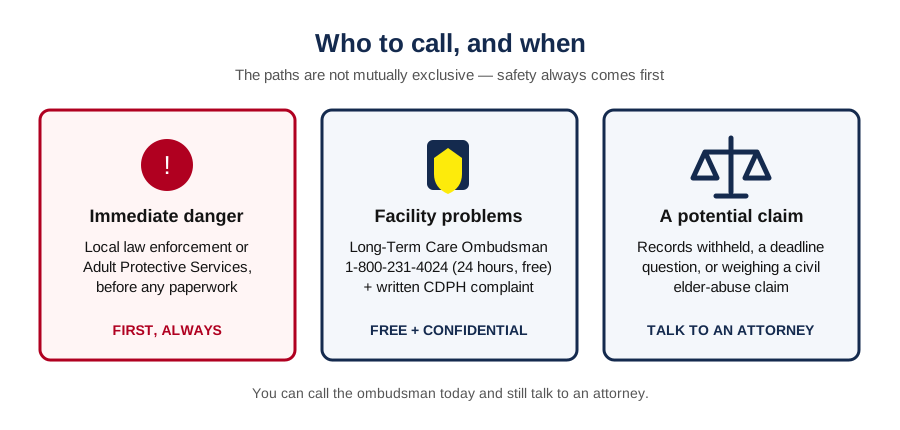
Immediate danger goes to law enforcement or APS first; facility problems go to the ombudsman and CDPH.
Is it too late? Deadlines, and what counts as “elder abuse” versus ordinary negligence
Two fears usually arrive together: “have I run out of time?” and “was this really abuse, or just an accident?” Both deserve straight answers, and both are reasons to talk to an attorney sooner rather than later.
On deadlines, the honest answer is that it depends on the claim. California sets a specific limit for elder financial abuse: an action must generally be brought within four years after the plaintiff discovered, or should have discovered, the facts, under Welfare and Institutions Code section 15657.7. For physical abuse and neglect, the limit is different and less uniform, generally ranging from about one to several years depending on the type of claim and when the harm was discovered. Please treat that range as informational only, not as a deadline for your case, and have a lawyer confirm your specific date, because the clock may already be running.
On the “abuse versus negligence” question, California law draws a real line, worth understanding without over-reading it. Ordinary negligent medical treatment is generally handled as professional negligence under the state’s medical malpractice framework and its damage limits. Reckless neglect under the Elder Abuse Act is different: in Delaney v. Baker (1999), the California Supreme Court held that reckless neglect of an elder is not simply “professional negligence.” The Act’s stronger remedies still require proof of recklessness, oppression, fraud, or malice, and remain hard to reach. This is a legal distinction, not a prediction. Every case is different, and none of this means any particular family’s claim will qualify. A careful attorney evaluates the facts before anyone can say how the line applies to you.
How an attorney can help
Part of taking your power back is knowing that many of the first, most important steps are yours to take right now. You can request the records, call the ombudsman, and report immediate danger yourself. Those tools belong to you today, at no cost.
An attorney can help most at the next stage: when records are being withheld, when a deadline question is real, or when you are weighing whether to bring a civil elder-abuse claim, especially now that AB 251 has changed how a facility’s own conduct can affect the burden of proof. And because this law is so new that no court has yet interpreted it, a careful attorney’s job is to tell you plainly what is settled and what is not, rather than promise a result on an untested question.
If a language barrier is part of what makes this harder, that barrier can come down. At Lilit Gevorgyan Professional Law Corporation, consultations and representation are available in English, Spanish, Russian, and Armenian, so a frightened family can explain what happened in their own words.
Talk to us about what happened
If a facility is stonewalling you, or you are not sure whether what you are seeing is abuse, tell us what happened. We will evaluate your situation, and if it falls outside our practice, we can connect you with an attorney from a vetted network of California attorneys.
Request a free consultation or call (310) 900-9300.
You pay nothing unless we recover compensation for you. Costs and expenses may apply. See engagement letter for details.
Results depend on the facts of each case; prior results do not guarantee a similar outcome.
See also: The Nursing Home Feels Hot.
Frequently asked questions
Can a nursing home legally destroy my parent’s medical records in California?
Not the records it is required to keep. California regulation 22 CCR section 72543 requires a skilled nursing facility to keep a patient’s health records for at least seven years after discharge, so a facility that shreds records inside that window is usually violating a retention rule, not following one. AB 251 adds a second consequence: if a court finds a residential care facility for the elderly, an adult community care facility, or a skilled nursing facility intentionally destroyed or hid required records to prevent their production, that destruction can count against the facility in an elder-abuse case. A single lost page is not automatically illegal; the law targets intentional concealment, and the court must make its finding in writing.
How long does a nursing home have to give me records I requested?
Under the federal rules for nursing homes, a facility must let you inspect the records within 24 hours of your request, not counting weekends and holidays. If you ask for copies, it generally must provide them within two working days. Under California law, it may charge only a reasonable, cost-based fee, capped at 25 cents per page for paper copies (50 cents per page for microfilm). Put your request in writing, date it, and keep a copy. You can document what happened and report it to the California Department of Public Health, which oversees licensed facilities statewide.
Who is allowed to request a nursing home resident’s records?
California’s records-access rules let several people ask, not only the resident. The resident may request their own records. So may a court-appointed guardian or conservator, and a health-care agent named in the resident’s power of attorney. After a resident dies, a beneficiary under the will or trust, or an heir who would inherit, may also request the records. If you are unsure which category fits you, gather the paperwork that shows your role, such as the conservatorship order, the power of attorney, or the will or trust, and bring it when you make the request.
Is there a deadline to bring an elder abuse claim in California?
Yes, and the deadline depends on the kind of claim. For elder financial abuse, California generally requires an action within four years after the plaintiff discovered, or reasonably should have discovered, the facts (Welfare and Institutions Code section 15657.7). For physical abuse and neglect claims, the time limit is different and less uniform; depending on the type of claim and when the harm was discovered, it generally ranges from about one to several years. That range is informational only. Because missing a deadline can end a claim entirely, have an attorney confirm the exact deadline for your specific facts as early as possible.
Should I call the long-term care ombudsman, Adult Protective Services or the police, or a lawyer?
It depends on what you are worried about right now. If you believe your loved one is in immediate danger, call local law enforcement or Adult Protective Services first; safety comes before paperwork. For problems with the facility itself, such as poor care or rights violations, the California Long-Term Care Ombudsman is a free, confidential first stop, reachable on the Statewide Ombudsman Hotline at 1-800-231-4024, operated 24 hours a day by the California Department of Aging. These paths are not mutually exclusive; you can call the ombudsman today and still talk to an attorney. If your situation falls outside our practice, we can connect you with an attorney from a vetted network of California attorneys.