
In 2026, California’s MICRA cap on non-economic damages in medical malpractice cases rose to $470,000 for most claims and $650,000 for wrongful-death claims. Economic damages, such as medical bills and lost wages, remain uncapped.
Waking up from a surgery that went wrong is hard enough without also trying to make sense of California’s malpractice law. Search online for what a case like this is worth, and you will find years of older articles quoting a flat $250,000 cap that stopped being the law in 2023. The real number is higher now, it changes every January, and it has only ever applied to one part of a case. Here is what actually changed in 2026, what the cap does not touch, and how long you have to act.
What changed in California’s medical malpractice cap in 2026
As of January 1, 2026, California caps non-economic damages, the part of a malpractice award for pain, suffering, and disfigurement, at $470,000 in most cases. If the malpractice caused the patient’s death, the cap for a wrongful-death claim is $650,000. Both figures are set by Assembly Bill 35, signed in 2022 and effective January 1, 2023, which built a yearly step-up into California Civil Code section 3333.2, the statute first enacted under MICRA in 1975, whose flat $250,000 cap AB 35 replaced.
Neither number is a one-time adjustment passed this year. Both are simply the 2026 rung on a ladder that started climbing in 2023 and keeps rising every January.
What MICRA is, and what the cap actually covers
MICRA stands for the Medical Injury Compensation Reform Act, a California law first passed in 1975 in response to a medical malpractice insurance crisis at the time. For nearly five decades, it capped non-economic damages in a malpractice case at a flat $250,000 that never moved, regardless of inflation. That frozen figure stayed in place until AB 35 took effect on January 1, 2023, replacing it with the rising schedule described above.
It is worth saying plainly what the cap is not. It is not a limit on whether a patient can bring a malpractice claim, and it is not a limit on every dollar a court or settlement can award. It is a ceiling on one specific category of loss, not a prediction of what any case is worth. The cap now lives in California Civil Code section 3333.2.
Non-economic vs. economic damages: what the cap touches
California malpractice law sorts the harm from an injury into two categories, and the MICRA cap touches only one of them.
- Non-economic damages (capped). Pain, suffering, disfigurement, physical impairment, and loss of enjoyment of life. This is the category limited to $470,000, or $650,000 in a death case, under Civil Code section 3333.2.
- Economic damages (not capped). Past and future medical bills, lost wages and lost earning capacity, and the cost of future medical or custodial care. California law places no statutory ceiling on this category in a malpractice case.
This distinction is the most misunderstood part of MICRA. A patient with catastrophic, expensive injuries is not limited to $470,000 in total; that number applies only to the pain-and-suffering portion of the case. Medical bills and lost income are calculated separately, and California law does not cap them.
How the annual increases work
AB 35 did not just raise the cap once. It wrote in an automatic increase, on a fixed schedule.
| Year | Cap (patient survives) | Cap (wrongful death) |
|---|---|---|
| 2023 (AB 35 took effect) | $350,000 | $500,000 |
| 2026 (current) | $470,000 | $650,000 |
| 2033 (scheduled) | $750,000 | $1,000,000 |
The non-death cap rises $40,000 every January through 2033, when it reaches $750,000. The wrongful-death cap rises $50,000 every January over the same period, reaching $1,000,000 by 2033. After 2033, both figures are set to keep rising, by about 2 percent a year, with no stated end date in the statute. The current figures of $470,000 and $650,000 reflect three annual step-ups since the schedule began in 2023, and you can read the schedule itself in Civil Code section 3333.2.
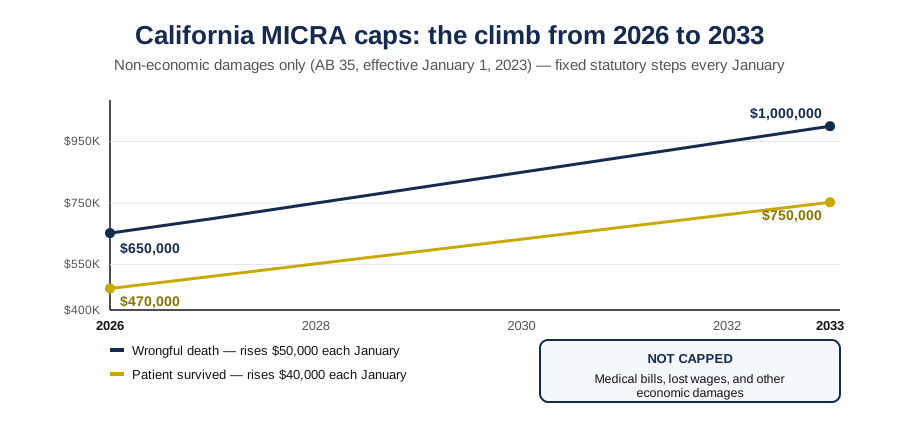
The caps move on a fixed statutory schedule, not with inflation or with the facts of a case. Economic damages (medical bills, lost wages) are not capped at all.
AB 35 also allows separate caps when a claim names both a health care provider and a health care institution as separate defendants. How that plays out is fact-specific and depends on the actual defendants, not something a general article can resolve.
What this means for patients and families
It is tempting to read a number like $470,000 and treat it as an estimate of what a case is worth. It is not. The cap limits only the non-economic portion of a case. The economic portion, often the larger figure when there is ongoing care, is calculated separately and differs in every case: a claim involving a lifetime of future medical care can be worth far more than the non-economic cap alone would suggest, and one with modest economic losses far less.
The cap is not a target, a promise, or an estimate of what any claim is worth. Every case turns on its own facts, and the cap simply marks the outer edge of what a court may award for non-economic harm in a given year.
Deadlines: California’s medical malpractice statute of limitations
None of this matters if the deadline has already passed. California’s time limit for medical malpractice claims is shorter and more complicated than the limit for many ordinary injury cases.
Under Code of Civil Procedure section 340.5, an adult generally must file a medical malpractice lawsuit within three years of the date of injury, or within one year of the date they discovered, or reasonably should have discovered, the injury, whichever comes first. In plain terms, the one-year discovery clock and the three-year outer limit run together, and the earlier of the two usually controls.
There are exceptions that can change the math. The statute allows for tolling, meaning the clock can pause, in specific situations such as proven fraud or intentional concealment, or a foreign object left in the body with no medical purpose. Different rules apply to injuries to minors. Because these deadlines are strict and missing one can end a claim before it starts, it is worth confirming your deadline early.
How an attorney helps in a medical malpractice claim
Medical malpractice cases are among the more procedurally demanding claims in California. They usually require testimony from a qualified medical professional to establish that the care fell below the accepted standard, and they run under MICRA’s specific rules. An attorney’s role is to handle that process: gathering and reviewing the records, working with medical professionals who can evaluate the care, identifying the responsible parties, calculating the uncapped economic losses, and meeting the deadlines.
When the harm is serious or the deadlines are close, having someone who knows the process can matter. Whether pursuing a claim makes sense in your situation is a case-by-case judgment, and that is exactly what a consultation is for.
When the malpractice happens inside a nursing home or care facility, the same events can raise separate elder-abuse questions alongside the malpractice claim.
If a language barrier is part of what makes this harder, it does not have to be. At Lilit Gevorgyan Professional Law Corporation, consultations and representation are available in English, Spanish, Russian, and Armenian.
Talk to us about what happened
If you or a family member was seriously harmed by medical care in California, tell us what happened and we will evaluate your situation. If a matter falls outside what our firm handles, we can connect you with another attorney licensed in California.
Request a free consultation or call (310) 900-9300.
You pay no attorney’s fees unless your case results in a settlement or award. Costs and expenses may apply. See engagement letter for details.
Results depend on the facts of each case; prior results do not guarantee a similar outcome.
Frequently asked questions
What is the MICRA cap in California for 2026?
In California, the 2026 MICRA cap on non-economic damages in a medical malpractice case is $470,000 if the patient survived, or $650,000 if the malpractice caused the patient’s death. It limits only non-economic damages, such as pain and suffering, not medical bills or lost income.
The cap comes from Assembly Bill 35, effective January 1, 2023, which replaced MICRA’s long-frozen figure with amounts that rise on a fixed yearly schedule: the non-death cap by $40,000 each January and the wrongful-death cap by $50,000 each January, through 2033. Before AB 35, the cap had been a flat $250,000 since 1975. Because the schedule changes every year, any online source quoting a single dollar figure without a year attached should be treated as potentially out of date. The cap is a limit on what a court may award for non-economic harm, not a prediction of what any case is worth.
Does the MICRA cap limit all damages, or just some?
No. In California, the MICRA cap under Civil Code section 3333.2 limits only non-economic damages, meaning pain, suffering, disfigurement, and similar losses. It does not limit economic damages such as medical bills, lost income, or the cost of future care. In 2026 the non-economic cap is $470,000 in most cases and $650,000 in wrongful-death cases.
This split exists because MICRA was written to limit subjective, hard-to-value losses while leaving the measurable, bill-based losses alone. A patient’s medical expenses and lost paycheck do not shrink to fit inside a legislative cap; only the pain-and-suffering portion does. The law caps that pain-and-suffering portion at $470,000 in most cases, while the separate, uncapped economic damages are calculated on their own from the actual bills and losses. That is why two cases with an identical non-economic award can still resolve very differently once their economic damages are added in. It is a limit on what a court may award, not a statement of what any case is worth.
Is there a limit on medical bills or lost wages in a malpractice case?
No. In California, medical bills, lost wages, and the cost of future medical or custodial care are economic damages, and the MICRA cap does not apply to them. The cap covers only non-economic damages, such as pain and suffering, which for 2026 is $470,000 in most cases and $650,000 in wrongful-death cases.
Economic damages are meant to compensate the concrete financial consequences of an injury, so the law lets them be proven from the evidence, the actual bills, wage records, and projections of future care, rather than from a statutory formula. That includes hospital bills, rehabilitation, income lost while unable to work, reduced future earning capacity, and the projected cost of long-term care. Under California Civil Code section 3333.2, none of that falls under the MICRA cap. In a serious, long-term injury the economic damages can be the larger part of the picture, even though the non-economic cap draws most of the attention. What any case involves depends entirely on its own facts and the proof presented; only non-economic damages, the human losses like pain and suffering, are capped.
How long do I have to file a medical malpractice claim in California?
In California, the deadline to file most medical malpractice claims is three years from the date of injury, or one year from the date you discovered, or reasonably should have discovered, the injury, whichever comes first. This deadline comes from Code of Civil Procedure section 340.5.
The two clocks run at the same time, and the earlier one usually controls, which is why acting promptly matters. There are exceptions that can pause, or toll, the clock. Under section 340.5, tolling can apply in cases of proven fraud or intentional concealment, or when a foreign object with no medical purpose is left in the body, and separate rules apply to injuries to minors. Because the deadlines are strict and missing one can bar a claim entirely, and because gathering records and arranging a medical review takes real time, it is worth confirming your specific deadline early rather than assuming you have years to decide. A lawyer can tell you which clock applies to your situation.
Will the MICRA cap keep going up after 2026?
Yes. Under California’s AB 35, the MICRA caps rise every January 1. The non-economic caps climb in annual steps through 2033, when they reach $750,000 for most claims and $1,000,000 for wrongful-death claims, and after that they rise by about 2 percent each year.
The schedule is built into the statute. For non-death cases the cap began at $350,000 in 2023 and rises $40,000 a year; for wrongful-death cases it began at $500,000 and rises $50,000 a year over the same ten-year stretch, so the 2026 figures of $470,000 and $650,000 are simply the current rung on those two ladders. Because the increases are already written into the law, they take effect automatically each January without new legislation, which is part of why articles quoting a single flat number can go stale within a year. The original 1975 MICRA cap sat at a flat $250,000 and was never adjusted for inflation for almost fifty years, which is why the legislature built these automatic step-ups into AB 35. These figures apply only in California and only to non-economic damages.