
Lane splitting is legal in California, but it was never actually illegal to begin with. A 2016 law formally defined the practice and let the CHP publish safety guidance; it did not flip lane splitting from banned to allowed.
If you ride in California, you have probably heard three different versions of the same story: that lane splitting is legal, that it was “made legal in 2016,” and that the CHP sets a strict speed limit for it. Only the first of those is fully accurate, and even it comes with an asterisk. The truth is more interesting, and it matters if you are ever hurt while splitting lanes. This guide walks through what the law says, what the official safety guidance actually is (and why it keeps disappearing and reappearing), who tends to be at fault in a lane-splitting crash, and the deadlines that can quietly end a claim.
Was lane splitting ever illegal in California?
Here is the piece most articles get wrong. Before 2016, no California statute prohibited lane splitting. It was not “illegal and then legalized.” It sat in a gray area: nothing in the Vehicle Code banned it, courts and the California Highway Patrol tolerated it for decades, and California quietly became the one state where the practice was openly accepted.
What changed in 2016 was clarity, not permission. The Legislature passed Assembly Bill 51, which Governor Jerry Brown signed on August 19, 2016, effective January 1, 2017. AB 51 added a brand-new section to the Vehicle Code, California Vehicle Code section 21658.1. The CHP itself has been blunt about what that bill did and did not do: it did not change existing law. Lane splitting was already not prohibited. What the statute added was a formal definition of the practice and explicit authority for the CHP to develop educational safety guidance. So the accurate phrasing is not “California legalized lane splitting in 2016.” It is closer to this: California law does not prohibit lane splitting, and section 21658.1 confirmed that and gave the CHP a clear role in guiding it.
Why does the distinction matter to you? Because insurers and defense lawyers sometimes argue, or imply, that a rider was doing something inherently unlawful. They were not. Lane splitting is a lawful, defined maneuver in California, and the framing you use after a crash can affect how a claim is evaluated.
What California Vehicle Code 21658.1 actually says
The statute is short, and reading it closely clears up several myths. California Vehicle Code section 21658.1 does two things. First, it defines “lane splitting” as riding a two-wheeled motorcycle, with both wheels on the ground, between rows of stopped or moving vehicles in the same lane, on a divided or undivided road. Second, it authorizes the CHP to develop educational safety guidelines for lane splitting, and directs the agency to consult with other traffic-safety bodies when it does so.
Notice what the statute does not do. It does not set a speed limit for lane splitting. It does not set a maximum speed difference between the motorcycle and surrounding traffic. It does not create a stand-alone “lane splitting” traffic offense. Every number you may have read (the often-repeated “10 mph faster than traffic” or “not above 30 mph” figures) comes from CHP guidance, not from the text of the law. That difference between statute and guidance is the source of most of the confusion, and it is where the story gets genuinely unusual.
The CHP safety guidelines: published, withdrawn, and back again
This is the part almost no competing article gets current, and it is the reason to read carefully before you trust a number you saw somewhere else.
The CHP first posted lane-splitting safety guidelines back in 2013. Those guidelines were pulled down around 2014 after a complaint that they might amount to an underground regulation the agency was not authorized to issue on its own. That concern is part of what led to AB 51 giving the CHP explicit authority in the first place. Then, in September 2018, the CHP worked with other state safety agencies and issued a new set of formal guidelines, the version that popularized the widely quoted speed figures. Reporting indicates those 2018 guidelines were later removed from the CHP website as well.
So what is the honest answer to “what is the official speed rule for lane splitting?” The honest answer is that the CHP has published, withdrawn, and revised numeric safety guidance more than once, and you should not treat any specific mph figure you read on a law-firm blog as settled, current, binding law. It never was binding law; guidance is not a statute. If you want the current version of the CHP’s safety recommendations, go to the source: the CHP’s California Motorcyclist Safety program page and confirm what is posted today. The safe, timeless rule for a rider is simpler than any number: split lanes only when you can do it safely and prudently for the actual conditions, because “unsafe for conditions” is exactly what can get you a ticket or shift fault onto you, no matter what the traffic speed is.
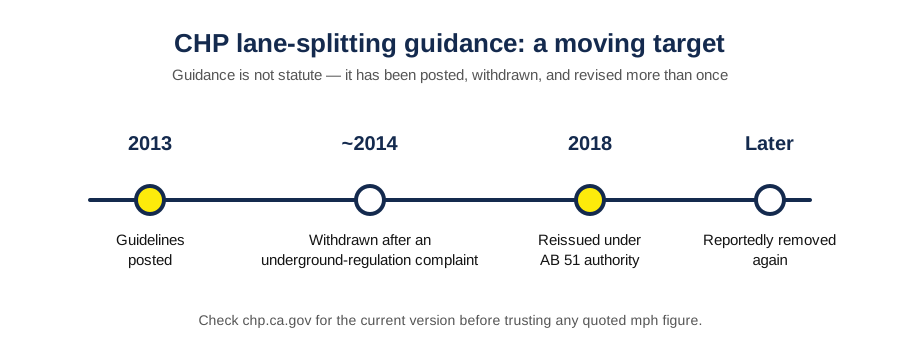
The CHP’s lane-splitting guidance has an on-again, off-again publication history. Guidance is not statute, and it changes.
Can you get a ticket for lane splitting in California?
Lane splitting by itself cannot be cited as an offense, because no statute prohibits it. But that is not the same as “anything goes.” An officer can still cite you for how you split lanes if the conduct breaks a different, pre-existing rule of the road.
Two statutes come up most often. The first is California Vehicle Code section 22350, the Basic Speed Law, which prohibits driving at a speed that is unsafe for conditions, regardless of the posted limit. Weaving between cars at a speed that is dangerous for the situation can violate 22350 even if you are technically under the posted freeway limit. The second is California Vehicle Code section 21658, which addresses unsafe lane changes and straddling lane lines. In short, the maneuver is legal, but the way you perform it is still governed by ordinary traffic law. Ride predictably, keep the speed difference reasonable, and do not force gaps that are not there.
Drivers have obligations too. It is not lawful to intentionally block or impede a motorcyclist who is lawfully splitting lanes, and it is not lawful to open a car door into traffic in a way that endangers a passing rider. The door hazard has its own statute, California Vehicle Code section 22517, the “dooring” rule. The broader “do not deliberately block a rider” point rests on existing traffic and negligence law rather than a single dedicated code section, so a driver who brake-checks or boxes in a splitting motorcyclist can still be found at fault under ordinary negligence principles.
Who is at fault in a lane-splitting accident?
There is no rule that a lane-splitting rider is automatically at fault, and no rule that the surrounding driver is automatically at fault. California uses pure comparative negligence, which means fault is measured as a percentage and damages are reduced by the injured person’s share of that fault. A jury is instructed on this through CACI No. 405, the standard comparative-fault instruction. If a rider is found 20 percent responsible for a crash, the rider’s recoverable damages are reduced by 20 percent, but the claim is not barred.
What actually drives the fault analysis is conduct. For the rider, the questions are practical: was the split done safely and prudently, or was the speed, speed difference, or weaving unreasonable for the conditions? For the driver, the questions are equally concrete: did they signal, check mirrors and blind spots, and change lanes safely, or did they drift or swerve into a rider they should have seen? Both sides are measured against the same standard of reasonable care.
There is a second layer when more than one driver is at fault. Under California Civil Code section 1431.2 (Proposition 51, 1986), economic damages such as medical bills and lost wages remain joint and several among at-fault defendants, but non-economic damages such as pain and suffering are allocated to each defendant only in proportion to that defendant’s own share of fault. In a multi-vehicle lane-splitting crash, that allocation can significantly change what any one defendant, or their insurer, ultimately pays.
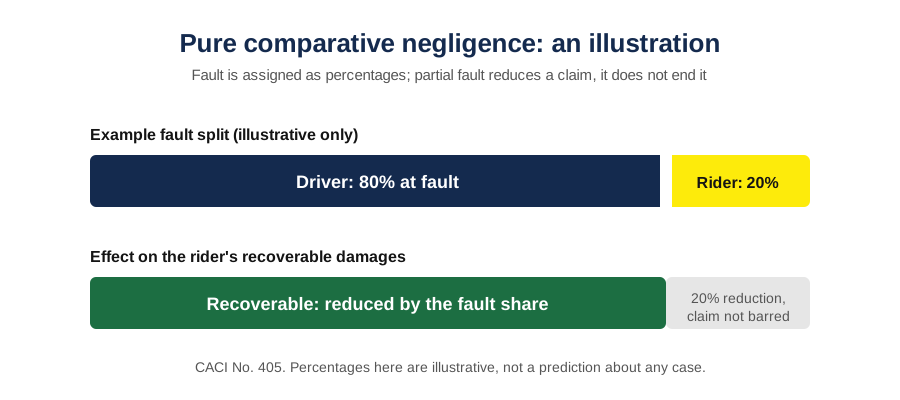
Under pure comparative negligence, a rider assigned partial fault still recovers, minus that percentage.
Lane splitting and your insurance: the uninsured motorist question
One of the most important, and most overlooked, questions after a motorcycle crash is what happens if the driver who hit you has little or no insurance. It happens often, and it is the reason to understand your own uninsured and underinsured motorist coverage, usually shortened to UM/UIM.
Every insurer in California is required to offer UM/UIM coverage to policyholders, though you can decline it in writing. If you accepted it, that coverage generally applies the same way whether you were on two wheels or four, so a motorcyclist hit by an uninsured driver while lawfully splitting lanes can typically look to their own UM/UIM coverage. One structural detail worth knowing: uninsured motorist property damage coverage is capped at $3,500 per accident under California law and comes with a deductible, so it is bodily-injury UM/UIM, not property-damage UM, that usually carries the weight after a serious motorcycle crash. Because California’s minimum coverage figures have been changing, we are not printing a specific dollar minimum here; confirm your own policy limits and the current statutory minimums before you rely on any number, and check the actual declarations page of your policy.
What to do after a lane-splitting crash in California
If you are hurt while lane splitting, the first priorities are medical, not legal: get evaluated, even for injuries that feel minor, because motorcyclists commonly underestimate them in the adrenaline of the moment. Once you are safe, a few concrete steps protect both your health and any future claim.
One duty that catches people off guard is the SR-1 report. Under California DMV rules, any driver involved in a crash in California that caused injury, death, or property damage over $1,000 must file a DMV form SR-1 within 10 days, regardless of fault and regardless of whether police responded. That filing is separate from any CHP or police report, and failing to file it can lead to a driver’s-license suspension. Because most lane-splitting crashes involve at least a minor injury, this duty is almost always triggered. Beyond the SR-1: document the scene if you safely can (photos of positions, lanes, damage, and skid marks), get the other driver’s information and any witness contacts, keep your gear rather than discarding it, and be careful about giving recorded statements to the other driver’s insurer before you understand your rights.
The deadlines that can quietly end your claim
California injury claims run on strict clocks, and missing one usually ends the case no matter how strong it was. The general rule for a personal-injury or wrongful-death claim against a private party is California Code of Civil Procedure section 335.1: two years from the date of injury. If the injured rider is a minor, the clock is generally tolled until the child’s 18th birthday under Code of Civil Procedure section 352, but do not assume tolling without confirming it for your facts.
There is a much shorter, easy-to-miss clock when a government entity may be responsible, for example a crash involving a government vehicle, or a dangerous road condition a public agency failed to fix. In that situation, California Government Code section 911.2 generally requires you to present a written claim to the public entity within six months of the injury before you can sue it. That is a prerequisite to filing suit, not the lawsuit deadline itself, and the six-month window has very limited exceptions. Most lane-splitting crashes are ordinary two-party cases where the two-year rule applies, but if a public entity or road defect is in the picture, the six-month clock can control, and it runs fast.
Talk to a California motorcycle-injury attorney in your language
Motorcycle cases turn on details: the exact way the split was performed, what the driver did in the seconds before impact, and how the fault percentages get argued. Those details are hard to protect when you are also recovering from an injury and fielding calls from an adjuster. Talking through your situation early, with someone who handles these cases, can help you understand what you are entitled to and what to expect, without any pressure to hire anyone.
One practical thing that matters in the Glendale, Burbank, and Pasadena communities we serve: language. At Lilit Gevorgyan Professional Law Corporation, consultations and representation are available in English, Spanish, Russian, and Armenian, so you can explain what happened in your own words. For many riders and their families, being fully understood is the difference between feeling handled and feeling heard.
See also: Motorcycle Accident Lawyer Serving Los Angeles.
Talk to us about what happened
Tell us what happened, and we will evaluate your situation. If it falls outside our practice, we can connect you with an attorney from a vetted network of California attorneys.
Request a free consultation or call (310) 900-9300. Tell us what happened.
You pay nothing unless we recover compensation for you. Costs and expenses may apply. See engagement letter for details. Results depend on the facts of each case; prior results do not guarantee a similar outcome.
Frequently asked questions
Is lane splitting legal in California?
Yes. Lane splitting is legal in California, and importantly, it was never expressly illegal here in the first place. No statute prohibited it before 2016, and courts and the CHP tolerated it for decades. In 2016, Assembly Bill 51 added California Vehicle Code section 21658.1, effective January 1, 2017. That section formally defines lane splitting as riding a two-wheeled motorcycle between rows of stopped or moving vehicles in the same lane, and it authorizes the CHP to publish educational safety guidance. The CHP has said the law did not change existing law; it defined the practice and gave the agency a clear guidance role. So the accurate statement is that California law does not prohibit lane splitting, rather than that California “legalized” something that had been banned.
Can you get a ticket for lane splitting in California?
Lane splitting by itself is not a citable offense, because no statute prohibits it and section 21658.1 did not create a stand-alone lane-splitting violation. But you can still be ticketed for how you do it. California Vehicle Code section 22350, the Basic Speed Law, prohibits any speed that is unsafe for conditions, even if you are under the posted limit, so splitting lanes too fast for the traffic around you can be cited. California Vehicle Code section 21658 covers unsafe lane changes and straddling lane lines, which can apply to erratic weaving between cars. In other words, the maneuver is lawful, but ordinary traffic rules still govern how you perform it. Ride predictably, keep your speed difference reasonable for conditions, and do not squeeze gaps that are not genuinely there.
Is there a speed limit for lane splitting in California?
No statute sets a speed limit or a maximum speed difference for lane splitting. California Vehicle Code section 21658.1 defines the practice and authorizes CHP safety guidance, but it does not put any number in the law itself. The often-quoted figures, such as “10 mph faster than traffic” or “not above 30 mph,” come from CHP educational guidance, not from a statute, and that guidance has an on-again, off-again history: it was posted in 2013, withdrawn around 2014, reissued in 2018, and reportedly later removed again. Treat any specific mph figure you read as guidance that can change, not binding law, and check the CHP California Motorcyclist Safety page for the current version. The durable rule is to split only at a speed that is safe and prudent for the actual conditions.
Who is at fault in a lane-splitting accident in California?
It depends on conduct, not on the fact that someone was lane splitting. California uses pure comparative negligence, and juries are instructed under CACI No. 405: each person’s fault is assigned as a percentage, and an injured rider’s recovery is reduced by their share but not barred. The analysis looks at whether the rider split safely and prudently and whether the driver signaled and checked blind spots before moving. When multiple drivers are at fault, California Civil Code section 1431.2 (Proposition 51) keeps economic damages such as medical bills joint and several, while allocating non-economic damages like pain and suffering to each defendant only in proportion to that defendant’s own fault. So the answer is rarely all-or-nothing; it is usually a percentage split that both sides argue over.
How long do I have to file a motorcycle accident claim in California?
For a claim against a private party, California Code of Civil Procedure section 335.1 generally gives you two years from the date of injury to file a personal-injury or wrongful-death lawsuit. If the injured rider is a minor, that clock is generally tolled until the 18th birthday under Code of Civil Procedure section 352. A shorter deadline applies if a government entity may be responsible, such as a government vehicle or a dangerous road condition: California Government Code section 911.2 generally requires a written claim to be presented to the public entity within six months of the injury before you can sue it. That six-month step is a prerequisite to filing suit, not the lawsuit deadline itself, and it has narrow exceptions, so identify any potential government defendant early.